 |
| Courtesy of Laura Gibbs |
Saturday, March 26, 2016
Week 9 Review

Growth Mindset: Commit
 |
| Courtesy of Laura Gibbs |
I figured I would share this post because I am currently committing to the goal of finishing this class, and I want to inspire others to give that final little bit of effort.
Learning by HEART: Empathy
 |
| Courtesy of Laura Gibbs |
I thought I would post this because I think on some level everyone gets anxious about important things in their lives. I figured that by sharing this image I could remind people that a little anxiety is normal , and it can help keep you focused on the important things.
Wednesday, March 23, 2016
Portfolio Guide
Week 2: The Forest
- A tale about karma inspired by the story of King Dasharatha's Karma. Let me know what you guys think.
- A story in which Hanuman complains to a silent audience about his grievances with Rama and Sugriva.
- I thought the story of Baka and the village he maintained control over was interesting, so I wrote a story that explored what the life of people living in that village could be.
- I tried to write a short morality story this week, inspired by my weekly reading.
Week 9 Storytelling: The Tiger and the King
Once long ago in the kingdom of Benares, a noble King ruled over the land. His name was Upendra, and he fiercely defended the borders from any threat. Any opposing kingdom would be met with the full strength of King Upendra's military, which he personally led into battle himself atop a large black warhorse. King Upendra was a mighty warrior and his actions in battle made all of his subjects respect and love him as a ruler. Outside of battle King Upendra was wise and fair to any who entered his royal court. The peasants who visited with worries or disputes could be sure that their problems would be addressed and any slights or injustices would be met with swift judgments from the King and his advisers. The only hobby the King set aside time for was visits to the royal forest, where he and his hunting party would slay animals for royal feasts.
In this forest lived a majestic white Bengal tiger. He was the King of the Forest. He protected all the creatures who lived in the forest from internal and external threats. If animals had disputes over territory and feeding grounds or logging crews were causing excessive habitat destruction, this tiger would step in and defend his loyal subjects and his forest. This tiger allowed hunters, both peasants and Kings alike, to hunt in the forest provided that they did not hunt excessively.
One day the King and his hunting party approached the forest, eager to refill their food stores since it had been a long time since King Upendra had visited the royal hunting grounds. They began the hunt almost immediately, with the king and his hunters cutting a path of destruction through the tiger's forest. The tiger, watching the horror from afar, immediately moved in to threaten King Upendra and his hunters. The King, seeing the majestic tiger blocking his path, immediately called off his hunters. The King and the tiger shared a mutual respect, and the tiger's appearance meant that something had gone wrong.
"Why, great tiger, do you block our path?" called out the King to the tiger. "It has been long since we have hunted this forest, and we have to fill our food storage."
The King's men stood at attention, looking tense as they waited for the tiger's reply.
"You take too much," calmly replied the tiger to the King and his men. "I have sworn to protect this forest, and I will continue to do so even against Kings and their warriors. I allow the hungry to hunt, on the condition that they are not greedy."
The King looked on at the tiger in thought, formulating his response.
"We take only enough to make up for our absence, nothing more. Why do you continue to harass us?" the King asked.
"It is not my fault that you have not visited the forest for so long that your supplies run out. If you take too much at once, my kingdom will never recover and I will have failed my subjects," said the tiger to King Upendra.
The King, seeing the wisdom in this argument, ended his hunt for the day and returned to his castle with his hunters. He vowed never to greedily hunt the forest again.
Author's Note: This week I read Twenty Jataka tales by Noor Inayat. This collection of short stories focused on human and animal interactions that almost seemed like children's bed time stories. For my storytelling this week I decided to do my best to emulate this style of story. Many of these stories deal with otherwise moral characters (often nobles and other associated royalty) who make errors in judgement one way or another. These people are then corrected by speaking animals, oddly enough, who are paragons of one moral activity or another. My story features a noble King who hunts in a forest which has a tiger as a king. I thought that having the characters occupy similar positions would make it a more interesting story to read than otherwise, though having a King get taught a lesson by a lowly rodent or bug could also have merit. I chose the picture I did because I wanted my readers to have a visual representation of the morally superior character, the tiger. The story seemingly abruptly ends, but many stories in the collection did. I think they were written this way so that they were simpler to understand as a reader. This is because my main inspiration was the Jataka Tales in general, not any particular story. I hope you guys enjoy.
Bibliography: Twenty Jataka Tales, by Noor Inayat. 1939. Link.
In this forest lived a majestic white Bengal tiger. He was the King of the Forest. He protected all the creatures who lived in the forest from internal and external threats. If animals had disputes over territory and feeding grounds or logging crews were causing excessive habitat destruction, this tiger would step in and defend his loyal subjects and his forest. This tiger allowed hunters, both peasants and Kings alike, to hunt in the forest provided that they did not hunt excessively.
 |
| A white Bengal tiger, courtesy of Animal Corner |
"Why, great tiger, do you block our path?" called out the King to the tiger. "It has been long since we have hunted this forest, and we have to fill our food storage."
The King's men stood at attention, looking tense as they waited for the tiger's reply.
"You take too much," calmly replied the tiger to the King and his men. "I have sworn to protect this forest, and I will continue to do so even against Kings and their warriors. I allow the hungry to hunt, on the condition that they are not greedy."
The King looked on at the tiger in thought, formulating his response.
"We take only enough to make up for our absence, nothing more. Why do you continue to harass us?" the King asked.
"It is not my fault that you have not visited the forest for so long that your supplies run out. If you take too much at once, my kingdom will never recover and I will have failed my subjects," said the tiger to King Upendra.
The King, seeing the wisdom in this argument, ended his hunt for the day and returned to his castle with his hunters. He vowed never to greedily hunt the forest again.
Author's Note: This week I read Twenty Jataka tales by Noor Inayat. This collection of short stories focused on human and animal interactions that almost seemed like children's bed time stories. For my storytelling this week I decided to do my best to emulate this style of story. Many of these stories deal with otherwise moral characters (often nobles and other associated royalty) who make errors in judgement one way or another. These people are then corrected by speaking animals, oddly enough, who are paragons of one moral activity or another. My story features a noble King who hunts in a forest which has a tiger as a king. I thought that having the characters occupy similar positions would make it a more interesting story to read than otherwise, though having a King get taught a lesson by a lowly rodent or bug could also have merit. I chose the picture I did because I wanted my readers to have a visual representation of the morally superior character, the tiger. The story seemingly abruptly ends, but many stories in the collection did. I think they were written this way so that they were simpler to understand as a reader. This is because my main inspiration was the Jataka Tales in general, not any particular story. I hope you guys enjoy.
Bibliography: Twenty Jataka Tales, by Noor Inayat. 1939. Link.
Sunday, March 20, 2016
Week 9 Reading Continued: Twenty Jataka Tales
This week I will be covering Twenty Jataka Tales by Noor Inayat, link. This post will cover Part B, and will also be the end of this reading.
- Most of these stories are taking place in Benares, I wonder if the stories originated there or if the author is connected to that location somehow.
 |
| Modern image of Benares, now known as Varanasi. From Varanasi Tourism. |
- I don't know why the original authors made the animals have superior morals, after all I would rather aspire to be like a village leader or king than a pig, even if that pig ends up wearing silk and advising a king.
- I feel like reptiles are underrepresented in these stories. Most of the stories focus on mammals because of their obvious connections to humans. But, I wonder if reptiles do not appear because of culture or a lack of reptiles in India.
- Many of these stories end with humans agreeing to stop hunting, but I feel like Indian society is not vegetarian. I wonder what impact, if any, stories like these had on people who had to hunt for food.
- The last few stories have been about accepting help when it is offered, even if it hurts the person offering it. I guess the message is to not ignore the sacrifices of others, and to give them the respect they deserve.
- I feel bad for the innocent quails that got killed with the two that argued. It seems unfair, they were still heeding the kings words.
- The story of the great goose finally explains why animals are moral superior in these stories. As the goose explains, humans may not always be honest but the words of animals can be trusted because they have simpler wishes.
That's the end of this book, thanks for reading.
Week 9 Reading Diary: Twenty Jataka Tales
This week I will be covering Twenty Jataka Tales by Noor Inayat, link. This post will cover Part A.
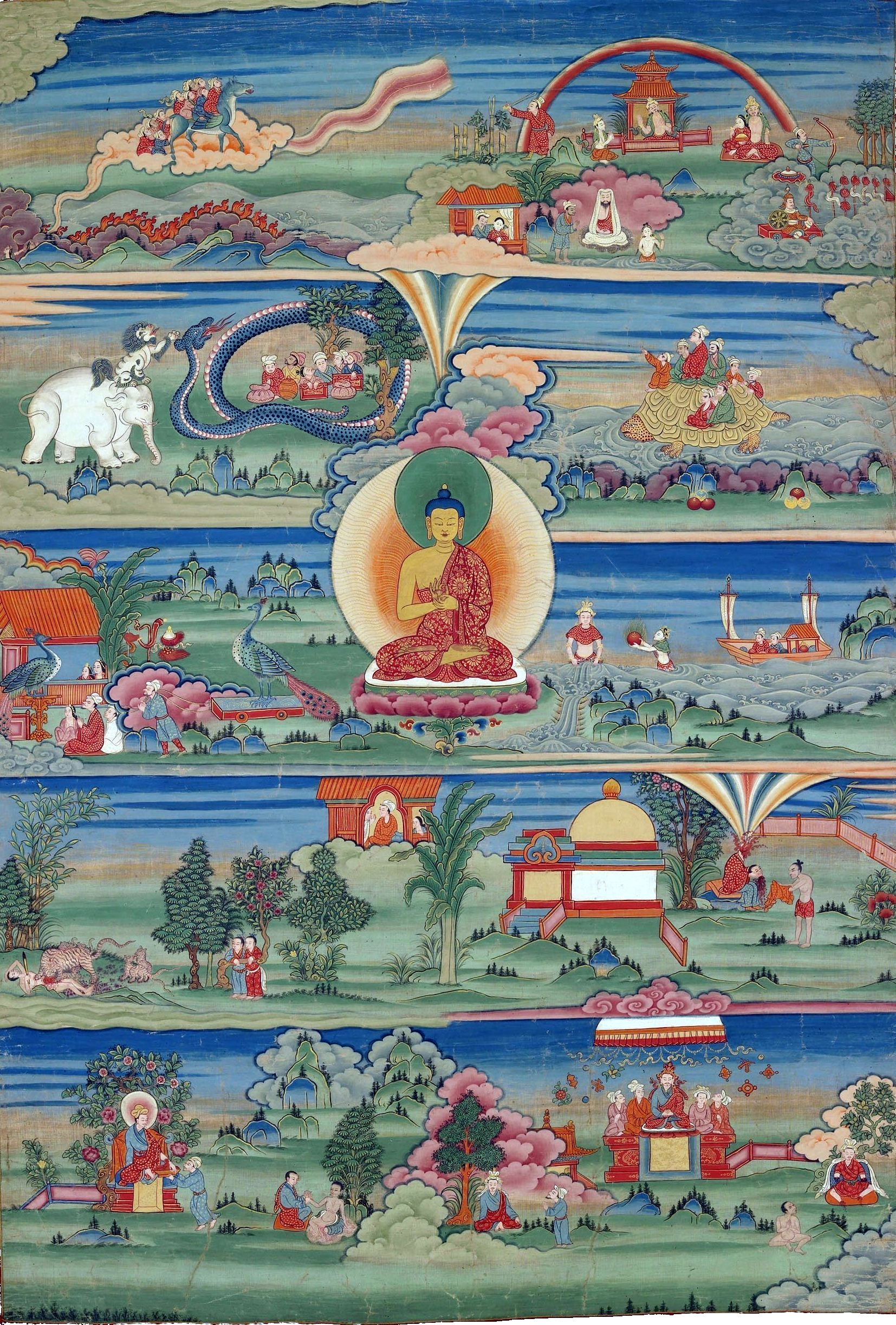 |
| Image depicting many Jataka Tales, from Wikipedia |
- These stories again are replacing humans with animals. I still find it odd that the Asian religions (to me at least) are the only ones who regularly do this.
- I don't know who is morally right in this first story, the monkeys or the men. Both want the fruit only for themselves.
- All of these animals seem to be choosing chiefs who are the greatest of their kind, and then these chiefs impart lessons to the human kings in their sacrifice.
- This story of the Deer and the King reminds me of Baka and the villages under his control.
- I'm just wondering how many animals had to die so that each King could learn every lesson they needed to.
- Also, if you actually met someone as morally righteous as the characters in these stories, they would likely be the most obnoxious person imaginable.
- I have read some of these stories in others collections of short stories for this class, I thought I was having deja vu until I realized it.
- These stories do make good replacements for parables, I suppose it is easier to keep people engaged with stories of animals than kings and peasants.
- I do not understand why the leaders in this story attempt to trick their followers into doing bad things, maybe it is to show their moral superiority and intelligence.
Subscribe to:
Posts (Atom)